
Common Is NOT Normal

“I just thought it was normal.” This is a phrase I hear from patients all the time. They are told by their friends, family members, or even their healthcare providers that the symptoms they are enduring are just a part of life – just deal with it. 

New flash: 

  • Peeing yourself with (insert any activity here) after having a baby → common not normal 
  • Having pain with sex for months after having a baby → common not normal 
  • Struggling with constipation or incontinence after menopause → common not normal 
  • Having pain with sex when you have never had a baby → common not normal 

There are many more examples but these are just a few of the most common ones I hear. It is SO important to recognize that just because a lot of people struggle with the same condition it does not mean you have to live with it. In fact, all of those conditions described above can be managed with lifestyle modifications and physical therapy in most cases. 

I always tell my patients – YOU know your body best. If something doesn’t feel right, it probably isn’t, it is worth investigating, and it is NOT. IN. YOUR. HEAD. People have a tendency to feel or be labeled as “crazy” for worrying about something that does not feel normal, especially if medical testing shows that everything is “normal”. Here’s the deal – tight and weak muscles, restricted connective tissue, and chronic inflammation typically do not show up on imaging or blood work. They show up as symptoms like incontinence, pain, and gut issues. 

So when and if you are told, “oh, well that’s just a part of being a woman/having a baby/getting old”, I challenge you to NOT accept that as an answer. Find providers who will LISTEN to you and will search WITH you. We are out there – I promise! 

Onward & Upward, 

Allison
So Wait… What Exactly Do You Do?

Whenever someone learns that I am a pelvic floor physical therapist, the question inevitably comes up, typically with some hesitation but intense curiosity – “So wait, what exactly do you do?” Or from my patients, I almost always get the question at some point – “So how exactly did you end up doing this type of physical therapy?” I love and welcome these questions!

Most people don’t even know what their pelvic floor is, never mind knowing you can get physical therapy for it! I always describe it like a knee injury. If you had pain, an injury, or surgery at your knee, you would expect to have physical therapy to recover from that. For some reason, our culture does not seem to apply the same to the pelvic floor – Europe on the other hand seems to have this figured out. 

Pelvic floor physical therapists treat a variety of conditions related to the pelvis including but not limited to urinary incontinence, pregnancy related pain, vaginismus, diastasis recti, constipation, pain with intercourse, low back/SI joint pain, and fecal incontinence. We can also help prepare the body for pregnancy, labor, and delivery in addition to help with the healing process postpartum. This is done through a variety of techniques such as manual therapy, strength training, retraining the nervous system, relaxation and stress management strategies, lifestyle modifications, and functional movement training. 

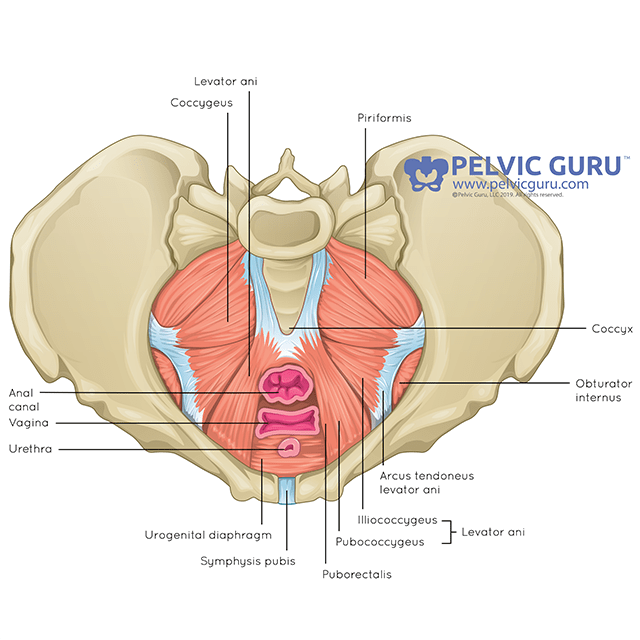
The pelvis is FILLED with muscles, connective tissue, nerves, and blood vessels – just like the knee (see image below). So, if there is damage to this area, say from carrying a baby for 9 months then pushing it out of your vagina or having a cesarean section (hello, tissue damage!), why would we not expect to rehab and heal the muscles, nerves, and connective tissue of that area? And this is just one example, pelvic floor rehab is not limited to pregnant and postpartum women in the slightest! I have seen patients ranging from the age of 7 to over 90 years old with a variety of different diagnoses, and the treatment plan for each patient varies just as much.  

Permission to use by Pelvic Guru, LLC

One reason I landed in this area of physical therapy is because it is very specific and very needed, but few people know about it. I wanted to be able to help those who did not know help existed for their problem, while also being a part of advocating for this area of physical therapy to become part of the norm. To me, the vagina and the pelvis are not “weird” – society and culture has created that stigma. It is NORMAL to pee, poop, have a period, and have sex, and your vulva, your vagina, and your rectum are simply ANATOMY – it’s only awkward if you make it awkward! I found that I could talk about these subjects in a way that seemed to normalize them for most people and could allow for a safe space to talk about vulnerable topics.  

So therein lies another reason to start this blog! A place to discuss and learn about the pelvic floor and all of the body systems related to it – how they should work, what can go wrong, and how almost any pelvic dysfunction can be treated and managed. My goal is to guide others as much as I can along the way. 

Onward & Upward, 

Allison